
NAMs@Cambridge

Human biology for the next generation of biomedical research
NAMs@Cambridge is a new CSCI initiative, bringing together a University-wide community developing New Approach Methodologies (NAMs) - including stem‑cell‑derived tissues, organoids and engineered human model systems - that allow scientists to study health and disease directly in human biology.
As biomedical research and drug development shift toward more human‑relevant experimental models, Cambridge is helping to shape the scientific foundations of this transition. By combining experimental innovation with large‑scale maps of human tissues, NAMs @ Cambridge is building a new generation of rigorously validated human in vitro models for discovery and translation.
Why Cambridge?
Cambridge offers a uniquely powerful environment for New Approach Methodologies, bringing together internationally leading strengths across multiple disciplines. Our community spans:
- Stem cell biology and organoid science
- Human developmental and disease biology
- Single‑cell and spatial genomics
- Bioengineering and quantitative biology
- Clinical research and human tissue studies
- Advanced AI-powered image analysis and Cell Atlas Bioinformatics
These complementary strengths make Cambridge one of the few places worldwide where human model development, human tissue analysis and computational atlases coexist at scale. This integration means our models are not only innovative, but firmly grounded in real human biology.
A transformative opportunity
New Approach Methodologies are rapidly becoming central to modern biomedical science. Human in vitro models are transforming:
- Mechanistic studies of human disease
- Drug discovery and target validation
- Analysis of patient samples in early clinical studies
- Safety assessment and regulatory science
At a time of accelerating scientific and regulatory change, the Cambridge Stem Cell Institute is well placed to help define the next generation of robust and reliable human experimental systems.
Anchoring models in human biology
A defining feature of NAMs @ Cambridge is the close integration of laboratory models with high‑resolution reference maps of real human tissues. Through strong links with large‑scale atlas efforts, including the Human Cell Atlas, our work connects lab‑grown models directly to authentic human biology.
This approach enables:
- Quantitative benchmarking of human models
- Improved reproducibility and comparability
- Iterative refinement of model systems
- Greater confidence in translation to the clinic
Together, these advances help establish human in vitro models as a rigorous and scalable foundation for biomedical research.
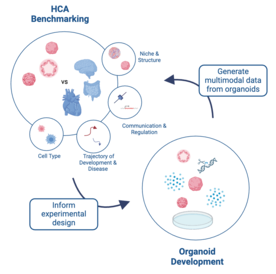
How it works: Researchers grow organoids (lab‑grown “mini‑tissues”), measure many types of data from them, and compare this with real human tissues. What we learn helps us design better experiments and build models that more closely reflect the human body.
Partnerships
NAMs @ Cambridge works closely with partners in universities, biotechnology and the pharmaceutical industry to speed up the development and uptake of human‑relevant model systems. These partnerships help turn advances in fundamental biology into real‑world impact for patients, regulators and society.