
McCaskie Group

Professor Andrew McCaskie
Regenerative therapies for bone and cartilage repair
Email: awm41@cam.ac.uk | Departmental Affiliation: Surgery, Division of Trauma and Orthopaedic Surgery
Laboratory: Addenbrooke's Hospital, Cambridge Biomedical Campus.
Research
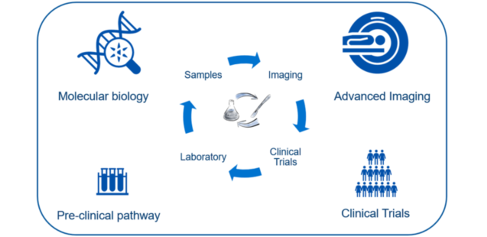
Research Focus: The McCaskie Group’s aim is to develop innovative therapies for musculoskeletal disease, particularly in cartilage injury and osteoarthritis (OA) which affects over 8 million people in the UK alone. He is currently developing translational pathways for regenerative therapy in this area, linking laboratory research with clinical treatment, including clinical trials.
Laboratory research programmes focus on the opportunity to use adult stem/ stromal populations, chondrocytes and other relevant cell types either alone or with tissue engineering approaches to target early disease. The research also considers the mechanisms underlying joint repair and regeneration after injury. Translational and clinical programmes seek to use experimental medicine approaches, particularly focused on imaging and tissue analysis. The latter includes cell characterisation by phenotype, single cell and spatial transcriptomics.
Clinical trial work includes the evaluation of stromal populations as a cell therapy in osteoarthritis of the knee. As the only UK centre, the McCaskie Group were part of a European consortium evaluating the use of adipose derived populations (ADIPOA2) in a phase IIb prospective, multicentre, double-blind, randomized versus placebo trial funded by the H2020 Programme of the European Union (grant: ADIPOA-2: n°643809).
Relating to precision health, to best match advanced therapies such as cell therapy to patients with specific triggers for OA, they have been working to define distinct subpopulations. Using a machine learning approach, they recently identified key predictors of OA progression, such as patient-reported outcome measures (PROMs) and MRI features and developed web-based applications to facilitate understanding and visualisation of personalised predictions.
Using this translational and stratified approach we seek to develop new cell and molecular approaches for cartilage repair to offer new treatments to patients with musculoskeletal conditions like osteoarthritis.
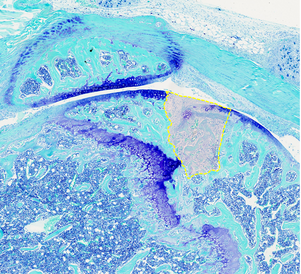
Immunofluorescence image of a section through a joint illustrating the cellularity (nuclei stained blue) of the articular cartilage and meniscus. The boundaries of the two apposing articular cartilage surfaces and the meniscal tissue are marked with yellow lines.
Key Publications
- Gadomski S, Fielding C, ... McCaskie AW, Robey PG, Méndez-Ferrer S. A cholinergic neuroskeletal interface promotes bone formation during postnatal growth and exercise. Cell Stem Cell. 2022 Apr 7;29(4):528-544.e9. doi: 10.1016/j. stem.2022.02.008. Epub 2022 Mar 10.
- Steinberg, J., Southam, L., Fontalis, A., Clark, M. J., Jayasuriya, R. L., Swift, D., . . . Zeggini, E. (2021). Linking chondrocyte and synovial transcriptional profile to clinical phenotype in osteoarthritis.. Ann Rheum Dis. doi:10.1136/annrheumdis-2020-219760
- Steinberg, J., Southam, L., Roumeliotis, T. I., Clark, M. J., Jayasuriya, R. L., Swift, D., . . . Zeggini, E. (2021). A molecular quantitative trait locus map for osteoarthritis.. Nat Commun, 12(1), 1309. doi:10.1038/s41467-021-21593-7
- MacKay, J. W., Nezhad, F. S., Rifai, T., Kaggie, J. D., Naish, J. H., Roberts, C., . . . Parker, G. J. M. (2021). Dynamic contrast-enhanced MRI of synovitis in knee osteoarthritis: repeatability, discrimination and sensitivity to change in a prospective experimental study.. Eur Radiol. doi:10.1007/s00330-021-07698-z
- Eldridge, S. E., Barawi, A., Wang, H., Roelofs, A. J., Kaneva, M., Guan, Z., . . . Dell'Accio, F. (2020). Agrin induces long-term osteochondral regeneration by supporting repair morphogenesis.. Sci Transl Med, 12(559). doi:10.1126/scitranslmed.aax9086
- MacKay, J. W., Kaggie, J. D., Treece, G. M., McDonnell, S. M., Khan, W., Roberts, A. R., . . . Gilbert, F. J. (2020). Three-Dimensional Surface-Based Analysis of Cartilage MRI Data in Knee Osteoarthritis: Validation and Initial Clinical Application.. J Magn Reson Imaging, 52(4), 1139-1151. doi:10.1002/jmri.27193
- Palmer, A.J.R., Ayyar Gupta, V., Fernquest, S., Rombach, I., Dutton, S.J., Mansour, R., Wood, S., Khanduja, V., Pollard, T.C.B., McCaskie, A.W., Barker, K.L., Andrade, T.J.M.D., Carr, A.J., Beard, D.J., Glyn-Jones, S., FAIT Study Group, 2019. Arthroscopic hip surgery compared with physiotherapy and activity modification for the treatment of symptomatic femoroacetabular impingement: multicentre randomised controlled trial. BMJ 364, l185. PMCID: PMC6365841
- Zengini E, Hatzikotoulas K, Tachmazidou I, ... McCaskie A, ... Zeggini E. Genome-wide analyses using UK Biobank data provide insights into the genetic architecture of osteoarthritis. Nature Genetics. 2018 Apr;50(4):549-558.
- Steinberg J, Brooks R, Southam L, ... McCaskie AW, Zeggini E. Widespread Epigenomic, Transcriptomic and Proteomic Differences Between Hip Osteophytic and Articular Chondrocytes in Osteoarthritis. Rheumatology (Oxford). 2018 Aug 1;57(8):1481-1489.
- Evangelou E, Kerkhof HJ. ... McCaskie A,... Valdes AM. A meta-analysis of genome-wide association studies identifies novel variants associated with osteoarthritis of the hip. Annals of the Rheumatic Diseases. 2014 Dec;73(12):2130-6.
- Elliott KS, Chapman K, Day-Williams A,... McCaskie A,... The arcOGEN consortium,... Zeggini E. Evaluation of the genetic overlap between osteoarthritis with body mass index and height using genome-wide association scan data. Ann Rheum Dis. 2013, 72(6), 935-941. PMCID: PMC3664369
- Zeggini E, Panoutsopoulou K, Southam L,... McCaskie A, Valdes AM, Spector TD, Loughlin J. Identification of new susceptibility loci for osteoarthritis (arcOGEN): a genome-wide association study. Lancet 2012, 380(9844), 815-823. PMCID:PMC3443899