
Duque-Correa Group

Dr Maria Duque-Correa
Tissue damage, regeneration and stem cell perturbation by parasitic worms
Email: mad75@cam.ac.uk
Research interests
The Duque-Correa Group's research includes infectious diseases, host-pathogen interaction and immunology. Trichuriasis is a major neglected tropical disease, affecting 500 million people worldwide, and caused by infection with whipworms. Whipworms are large parasites that live inside the gut lining. Whipworms remain in their host for years by interacting with the gut lining and surrounding cells to manipulate gut structure and immune responses. How the parasite mediates these interactions is not understood.
The Duque-Correa Grou aims to determine how whipworms invade, colonise and persist in the gut. Using a new model Maria developed based on “mini-guts”, the first to mimic whipworm infections in a lab dish, together with microscopy and sequencing, they are characterising: 1) the molecular and cellular changes that happen in the whipworm and the gut lining and surrounding cells when the parasite enters and colonises the gut and; 2) the interactions that allow the parasite to persist and the gut lining to repair during chronic infections. This knowledge will open new avenues to eradicate whipworm infections and control gut inflammatory diseases.
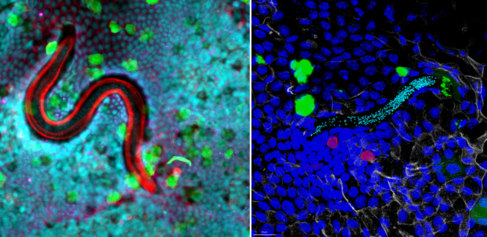
Trichuris muris first stage (L1) larvae infecting mouse caecaloids.
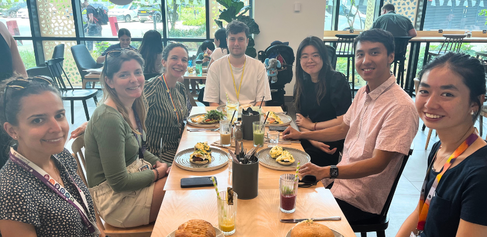
Duque-Correa Group photo 2025
Selected Publications
- Stark KA, Mkandawire TT, Tolley C, Thompson S, Fortune-Grant R, Brandt C, Clare S, Lawley TD, Cantacessi C, Almeida A, Grencis RK, Nejsum P, *Berriman M, *Duque-Correa MA. Host microbiome determines host specificity of the human whipworm, Trichuris trichiura. 2025. Preprint. bioRxiv. doi: 10.1101/2025.05.09.653168.
- Airs, P. M & *Duque-Correa MA. Resolving tissue and cellular functions of parasitic nematodes. 2025. Trends in Parasitology. doi: 10.1016/j.pt.2025.09.012.
- Hofer M, Duque-Correa MA, Lutolf MP. Patterned gastrointestinal monolayers with bilateral access as observable models of parasite gut infection. Nat Biomed Eng. 2024 Dec 4. Epub ahead of print.10.1038/s41551-024-01313-4
- Ruby White, Jose Roberto Bermúdez-Barrientos, Elaine Robertson, María A. Duque Correa, Amy H. Buck. 2-D organoids demonstrate specificity in the interactions of parasitic nematodes and their secreted products at the basal or apical intestinal epithelium bioRxiv 2024. doi: https://doi.org/10.1101/2024.12.16.628471
- Sarah Buddenborg, Alison A Morrison, Anna C Fletcher, Manuela R Kieninger, Bee Ling Ng, Kirsty Maitland, Jennifer McIntyre, Emily Hart, Dave J Bartley, Maria Duque-Correa, Stephen R Doyle Optimisation of single-nuclei isolation and RNA sequencing of parasitic nematodes bioRxiv 2024. doi: 10.1101/2024.11.13.623282
- David Goulding, Charlotte Tolley, Tapoka T. Mkandawire, Stephen R. Doyle, Emily Hart, Paul M. Airs, Richard K. Grencis, Matthew Berriman, María A. Duque-Correa. Hatching of whipworm eggs induced by bacterial contact is serine-protease dependent bioRxiv 2024.doi.10.1101/2024.08.15.608065
- Coghlan A+, Partridge FA+, Duque-Correa MA+, [+12 authors]. A drug repurposing screen for whipworms informed by comparative genomics. PLoS Negl Trop Dis. 2023, 17(9): e0011205. +Shared First Authorship. DOI: 10.1371/journal.pntd.0011205
- White R, Blow F, Buck, AH and Duque-Correa MA*. Organoids as tools to investigate gastrointestinal nematode development and host interactions. Front. Cell. Infect. Microbiol. 2022, 12;12:976017. DOI: 10.3389/fcimb.2022.976017
- Duque-Correa MA, et al. Defining the early stages of intestinal colonisation by whipworms. Nat Commun. 2022, 1;13(1):1725. DOI: 10.1038/s41467-022-29334-0
- Mkandawire, T, Grencis RK, Berriman, M and *Duque-Correa MA. Hatching of Parasitic Nematode Eggs: A Crucial Step Determining Infection. Trends Parasitol. 2022, 38(2):174-187. DOI: 10.1016/j.pt.2021.08.008
- Duque-Correa MA, et al. Development of caecaloids to study host-pathogen interactions: new insights into immunoregulatory functions of Trichuris muris extracellular vesicles in the caecum. Int J Parasitol. 2020; 50(9):707-718. DOI: 10.1016/j.ijpara.2020.06.001
- White R, [+5 authors], Duque-Correa MA and Buck A. Extracellular vesicles from Heligmosomoides bakeri and Trichuris muris contain distinct microRNA families and small RNAs that could underpin different functions in the host. Int J Parasitol. 2020; 50(9):719-729. DOI: 10.1016/j.ijpara.2020.06.002
- Duque-Correa MA, et al. Organoids – New models for host-helminth interactions. Trends Parasitol. 2020; 36(2):170-181. DOI: 10.1016/j.pt.2019.10.013
- Abeler-Dörner L, [+5 authors], Duque-Correa MA, [+51 authors]. High-throughput phenotyping reveals expansive genetic and structural underpinnings of immune variation. Nat Immunol. 2020; 21(1):86-100. DOI: 10.1038/s41590-019-0549-0
- Doyle SR, [+5 authors], Duque-Correa MA, [+18 authors]. Evaluation of DNA extraction methods on individual helminth egg and larval stages for whole genome sequencing. Front Genet. 2019; 10:826. DOI: 10.3389/fgene.2019.00826
- Duque-Correa MA, et al. Exclusive dependence of IL-10Ra signalling on intestinal microbiota homeostasis and control of whipworm infection. PLoS Pathog. 2019;15(1):e1007265. DOI: 10.1371/journal.ppat.1007265
*Corresponding author.